How to Increase Throughput With Auto Scheduling
Every shop hits the same wall: only so many machine-hours, only so many shifts. This being the case, you might be considering the benefits of a scheduling system. Ultimately, this may be the solve for working around capacity constraints faster than a whiteboard or spreadsheet can.
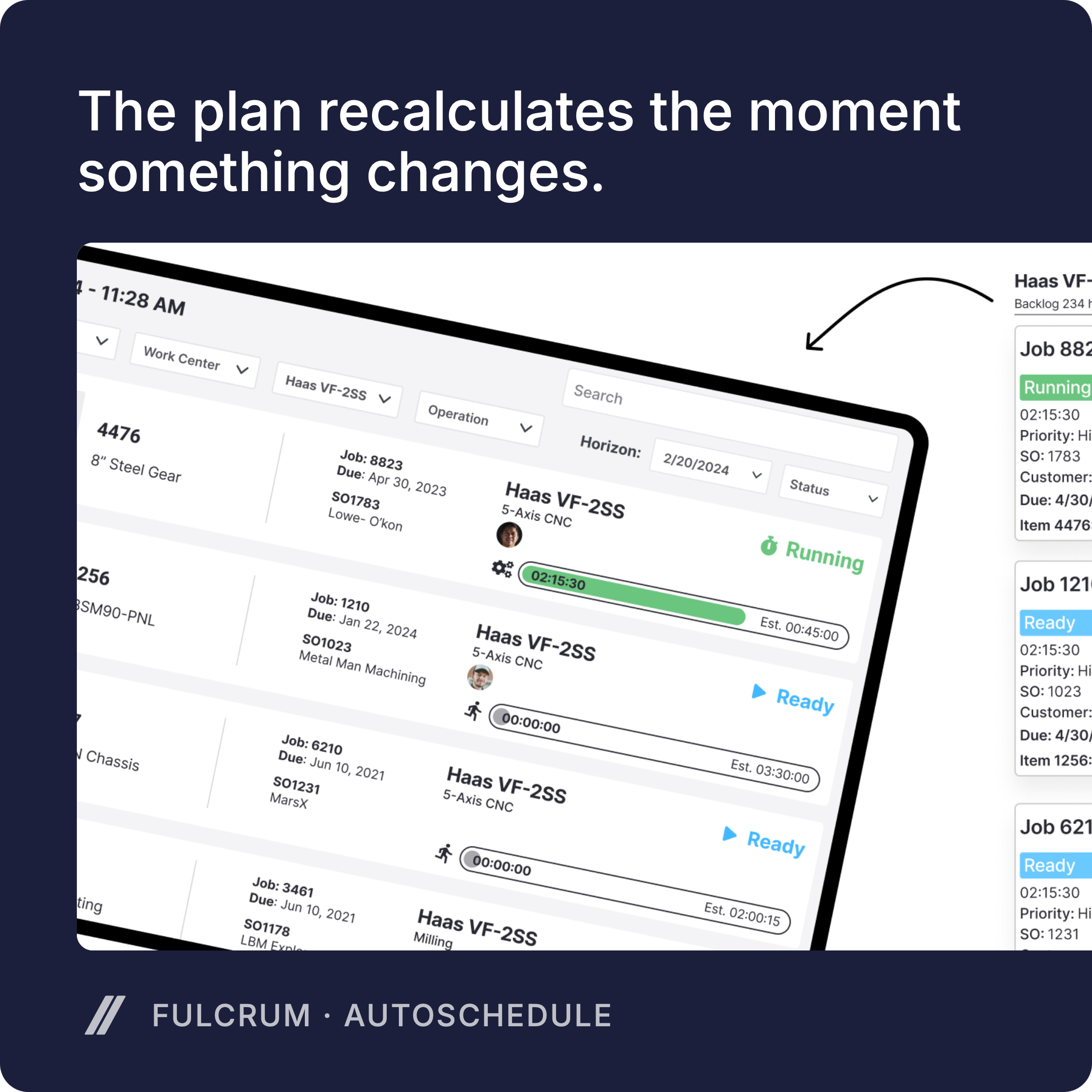
Automated production scheduling replaces manual sequencing with an algorithm that assigns jobs based on machine capacity, material availability, and due dates, then recalculates the moment something changes. This guide covers how it works, what it takes to implement, and how to measure whether it’s paying off.
Key Takeaways
- Automated scheduling sequences jobs against real constraints (machine capacity, materials, due dates) instead of best-guess planning.
- Real shops on automated scheduling see it directly: OMW Corporation sustained an 85%+ on-time delivery rate through a period of rapid growth, and Northeast Tool & Manufacturing, an AS9100D-certified aerospace and defense shop, cut quote-to-shipment on a complex aerospace order to 5 days, down from 4-6 weeks in their prior system.
- The schedule plan ands reacts. When material arrives late, someone calls in sick, or a job runs long, a connected scheduler adjusts automatically instead of waiting for someone to notice and manually rework the plan.
- Fulcrum’s Autoschedule generates a full production schedule in seconds and recalculates automatically as priorities shift.
- Clean routing data and accurate time estimates matter more than the software itself. Bad data produces a schedule nobody trusts, no matter how good the algorithm is.
What Automated Scheduling Actually Does
Automated scheduling assigns jobs to machines, operators, and work centers based on your shop’s real constraints: shift times, equipment capacity, material availability, and operation sequence. Change one variable and the whole plan recalculates in seconds, instead of forcing someone to manually update a dozen cells and hope nothing was missed downstream.
The distinction that matters most is finite vs. infinite capacity. Infinite capacity scheduling loads jobs against due dates without checking whether a resource is actually free, which produces a schedule that looks fine on paper and falls apart on the floor. Finite capacity scheduling only assigns a job when the resource has the time, which is why the plan actually holds.
Why a Connected Schedule Beats a Static One
A schedule is only as good as how fast it reflects reality. Most shops don’t lose time building the original plan — they lose it every time the plan stops matching the floor: a machine goes down, a rush order lands, an operation runs longer than estimated, someone calls in sick.
A system where scheduling and job tracking are the same connected tool can respond to those events instead of waiting for someone to catch them. When an operation that was scheduled for later gets started early, it moves to the top of the queue automatically. Operations already running or paused get priority on their equipment instead of getting bumped by the plan. Work that’s fallen behind schedule reschedules to the present instead of sitting stuck in the past on paper. None of that requires a planner to notice the problem first. The schedule is already working from current shop-floor status, not yesterday’s plan.
Automated scheduling means the plan continues to be true, even as the day goes sideways.
How It Increases Throughput
Throughput isn’t about running machines faster. It’s about closing the gaps: fewer idle machines, fewer overloaded bottlenecks, less time lost waiting on a plan that’s gone stale.
Setup time is one of the biggest levers most shops ignore. Every changeover is time the machine isn’t cutting, and in a high-mix shop running smaller batches, that adds up fast. Sequencing decisions that account for which jobs share tooling or fixtures reduce the changeovers a due-date-only sequence would create. This type of work is hard to do consistently by hand across a full queue.
Real-time rescheduling is where the actual time savings show up. When a machine goes down or a rush order lands, a static spreadsheet needs someone to manually work out the downstream impact — a multi-hour task automated scheduling exists to eliminate. Fulcrum’s Autoschedule recalculates the full plan and shows immediately which jobs slip and which delivery dates are now at risk.
Material and secondary constraints matter as much as machine time. A schedule that only checks machine availability will start jobs before materials arrive, which just moves the bottleneck to your floor as WIP. Tooling, fixtures, and specialized labor need to be tracked as constraints too, or the “optimized” schedule creates conflicts the algorithm never saw coming.
What to Look For in a Scheduling System
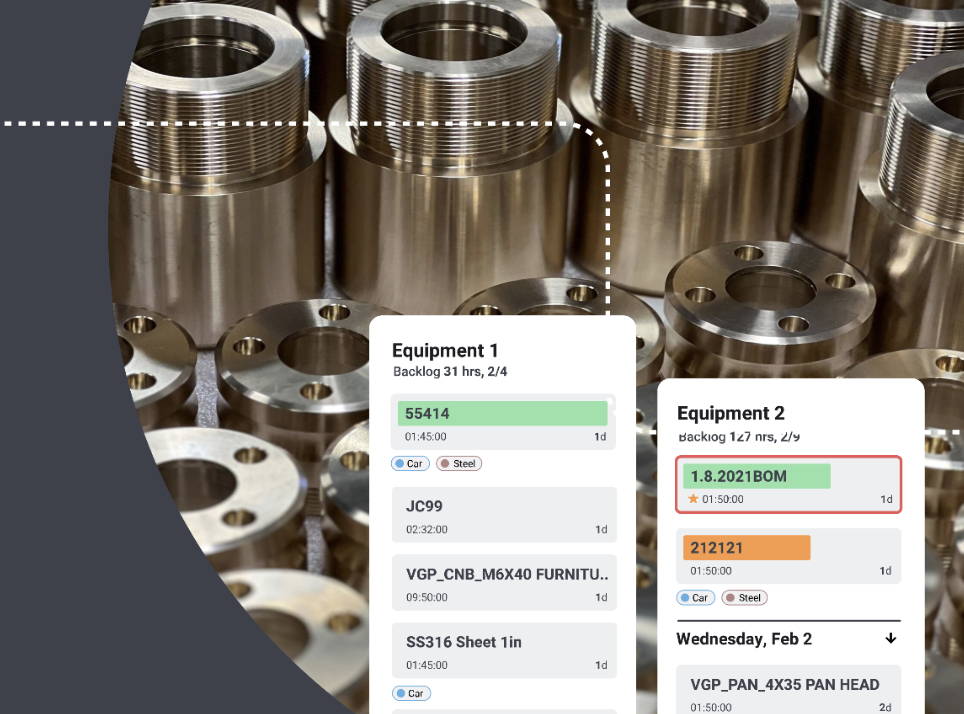
- A clear, up-to-date view of queue length by work center that lets planners override the algorithm when needed, with downstream jobs updating automatically.
- Material and resource tracking, not just machine capacity — the schedule should know what’s on hand, not just what’s theoretically possible.
- A system where job tracking and scheduling are connected, so the plan reacts to floor status (what’s running, what’s late, what’s behind) instead of just reacting to due dates.
Implementing It: The Short Version
- Clean your master data first. Work center definitions, routing accuracy, and time estimates are what the algorithm actually runs on. Bad data produces a schedule that doesn’t match reality, and once operators catch that, they stop trusting the tool.
- Set your priority rules. Due dates, customer tiers, and setup time all compete. Decide which wins before the algorithm has to guess.
- Run it in parallel for 2-3 weeks. Compare the automated schedule against what actually happens on the floor and fix data gaps before you rely on it for real decisions.
- Assign an owner. A scheduling tool with nobody maintaining it daily will drift. Even part-time ownership keeps it current.
Measuring Whether It’s Working
Track these before and after implementation:
- Lead time — average time from job release to completion, by work order type.
- On-time delivery rate — the clearest signal that the schedule reflects real capacity instead of wishful thinking.
- Bottleneck utilization — the percentage of available time your constraint work centers are actually running, not idle between jobs.
Quote-to-shipment time is another useful proxy, especially for shops quoting complex or custom work.
How Fulcrum’s Autoschedule Handles This
Autoschedule pulls from shift data, equipment specs, material availability, and operation sequence to generate a schedule in seconds, and recalculates automatically as new orders or priority changes come in. Planners can still drag-and-drop manual overrides on top of it; the system respects those and recalculates everything else around them.
Because scheduling and job tracking run on the same live, connected shop floor data, progress on the floor feeds the schedule directly: operations that start early jump the queue, running and paused operations hold their position instead of getting bumped, and anything that’s fallen behind reschedules to the present automatically. Inventory and purchasing planning factor into sequencing so jobs don’t start ahead of materials, and quoting can pull realistic due dates from current capacity instead of a sales rep’s best guess.
FAQ
How much throughput improvement can I expect? It depends heavily on how much inefficiency exists in your current process today — a shop running spreadsheets with stale routing data has more room to gain than one already close to finite-capacity scheduling. Track your own lead time, on-time delivery, and bottleneck utilization before and after to know your real number.
How long does implementation take? Timeline depends mostly on data readiness, not the software. Clean routing data and accurate time estimates can get a shop running in weeks; a shop that needs a full data cleanup first should plan for that phase up front. Speak with a Fulcrum team member to talk through what implementation would look like for your shop.
Does this work for high-mix, low-variability job shops? This is where automated scheduling matters most. Manual optimization gets impractical fast once you’re juggling many small, different jobs — an algorithm can evaluate sequencing options a person can’t hold in their head, and recalculates as priorities shift.
What happens when the schedule needs to change mid-day? The system recalculates the full plan and pushes the update to the floor. If a machine goes down or someone calls out, operations tied to that resource get reprioritized automatically rather than sitting in a queue that no longer reflects reality. With Fulcrum, operators see the change in Job Tracking without anyone having to manually communicate it.
Can I still make manual adjustments? Yes. Autoschedule supports drag-and-drop overrides after the initial schedule generates, and recalculates everything else around your changes.
What data does the algorithm need at minimum? Work center definitions with capacity, job routings with operation sequences, and time estimates per operation. Material availability and labor constraints improve accuracy and can be layered in after go-live.