
Product Updates
Weekly updates to Fulcrum, always included with your subscription.
Thank you! Your submission has been received!
Oops! Something went wrong while submitting the form.

Reworks and their NCRs (Non-Conformance Reports) used to be two disconnected records, even though the large majority of reworks end up with one. A new "Create NCR" checkbox on the Rework window (shown based on your permissions) now creates an NCR pre-filled from the rework — affected quantity, disposition, reason/notes, tied to the same job, operation, and part — and links the two records together. Works on both work-order jobs and plain (non-work-order) jobs.

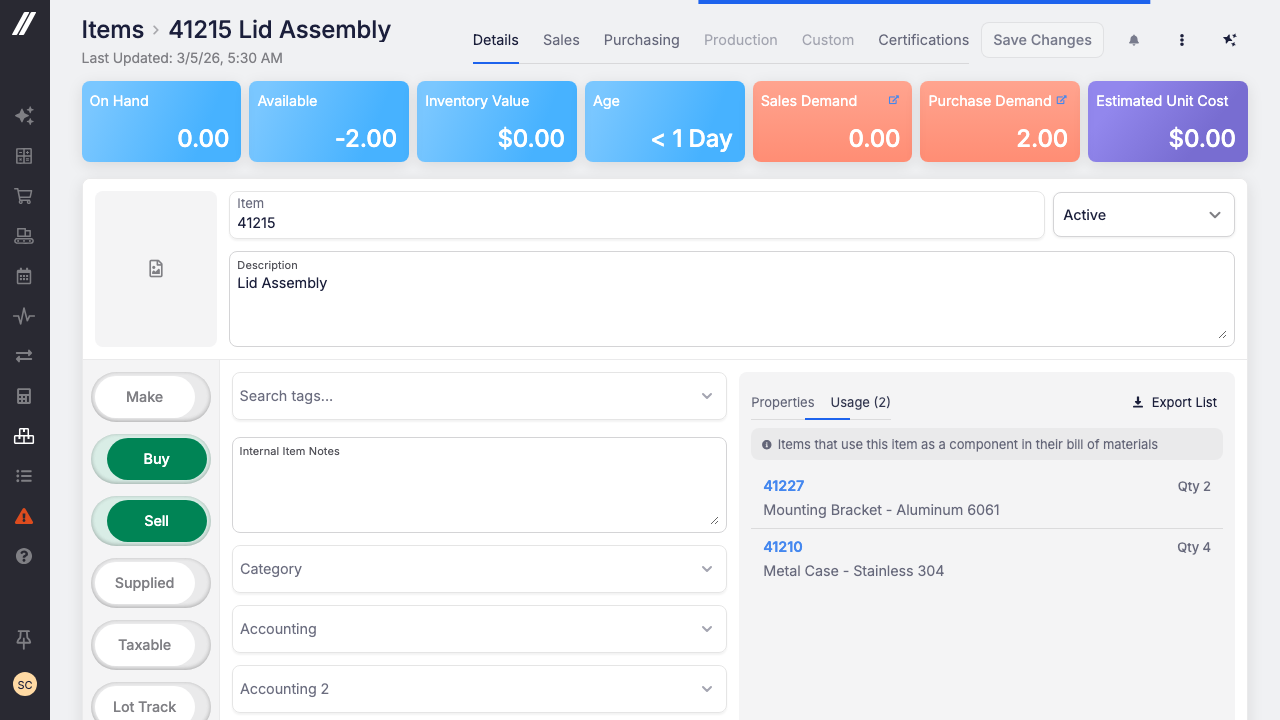
The Usage tab already lists every parent that uses an item as a component. It now shows how many of that item each parent's bill of materials calls for, so verifying a bulk edit is a quick scan down one column instead of opening each BOM one by one.
 Share ->
The Shipment List can now resolve and jump to a shipment directly from its shipment number, instead of hunting for it in the grid.
A new Shipping setting for shops that don't overship. Once a sales-order line has shipped its full ordered quantity, Fulcrum no longer leaves an extra open shipment line hanging around, so you can't accidentally ship or invoice more than was ordered. Turn it on under Settings → Shipping → Overshipping. Flipping it on also clears any of those extra lines already sitting on your open orders. It's off by default — nothing changes if you overship on purpose.
On the job tracking Run tab, operators had to flip the "Show Tools" toggle every time they opened an operation to see which measurement tool recorded each response. Tool info now shows by default, so it's visible immediately.
A new Type filter on the job tracking operations list, alongside the existing Department / Operations / Equipment dropdowns. Jobs and work orders used to be interleaved in one list with no way to narrow the board down to just work-order operations, or just rework — this adds that.
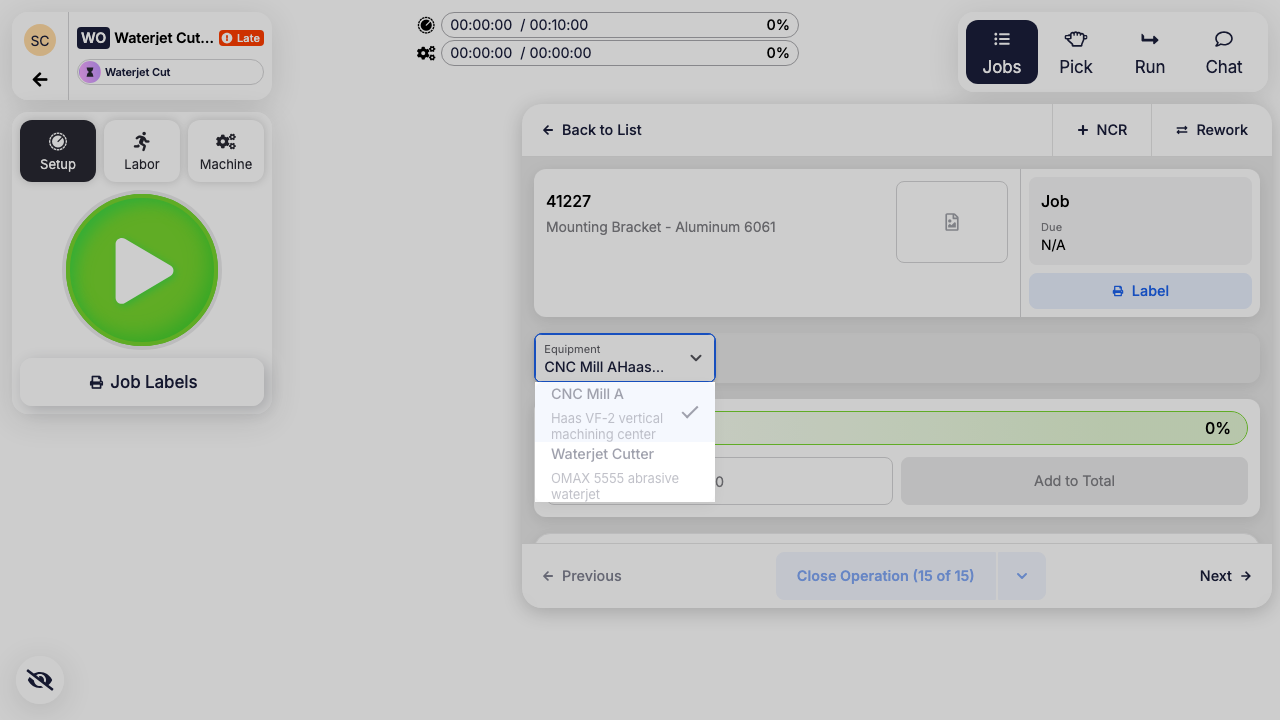
Operators can now change the equipment for a work order operation without leaving the Work Order Tracking screen. Open a job on the operation, pick the equipment from the new Equipment dropdown, and the change applies to every job on that work order operation at once, so all the jobs stay coordinated on the same machine instead of drifting apart.
 Share ->
Change orders can now hold file attachments, just like Sales Orders, Purchase Orders, and Quotes. To support that, new change orders are now created from a quick slide-out panel instead of a blank form, so every field on the change order, attachments included, always has a real record to belong to from the moment it's created.
Sales order lines can now be rolled forward with Delete & Rev, in addition to the existing Cancel & Rev — and the choice you make is remembered on the line going forward, so a rolled line reports which action it was rolled with. Cancel & Rev used to leave a placeholder line behind at zero quantity, which is the wrong outcome when a line is meant to simply be replaced; now you can pick the option that fits. Quote lines default to Delete & Rev only, since quote lines were already being removed on apply — the old dropdown just mislabeled it as a "Cancel." The Find Old Revs window also picked up the same record grid used elsewhere for finding related documents, and a broken link on that grid that used to lead to the wrong page has been fixed along the way.

Multi-factor authentication now takes an emailed one-time code as well as an authenticator app. Not everyone on the floor has an authenticator app, and setting one up is a real barrier for shared or occasional accounts — so enrollment now offers the choice, email-enrolled users get a matching sign-in challenge, and admins control who is allowed to use it. It's off by default; an admin turns it on for the shop.
A browser tab loads Fulcrum once and then runs that version until somebody reloads it. We've seen shop-floor screens still running a version of Fulcrum more than two months old, which means a shop can sit on behavior we've already changed for weeks after a release.
Every Fulcrum screen now notices when a newer version is out and refreshes itself at a safe moment. Unattended screens — job tracking tablets, time clocks, wall monitors — reload quietly, but only when it's provably safe: nothing open mid-workflow, nothing typed and unsaved, no half-entered quantity. If you're actively working, you get a small banner, and a countdown only in the last few minutes before the deadline.
Reordering bubbles no longer means typing a new number into each bubble's dropdown one at a time. Grab a bubble in the annotations panel and drag it where it belongs. Sibling bubbles move together — an anchor bubble and its indented sub-bubbles travel as one unit when you drag the handle in the bubble header.
Say you roll a job from Rev B to Rev C. The Rev B drawing on the job is now out of spec and has to go, but you couldn't delete it because it had annotations and bubbles attached to it.
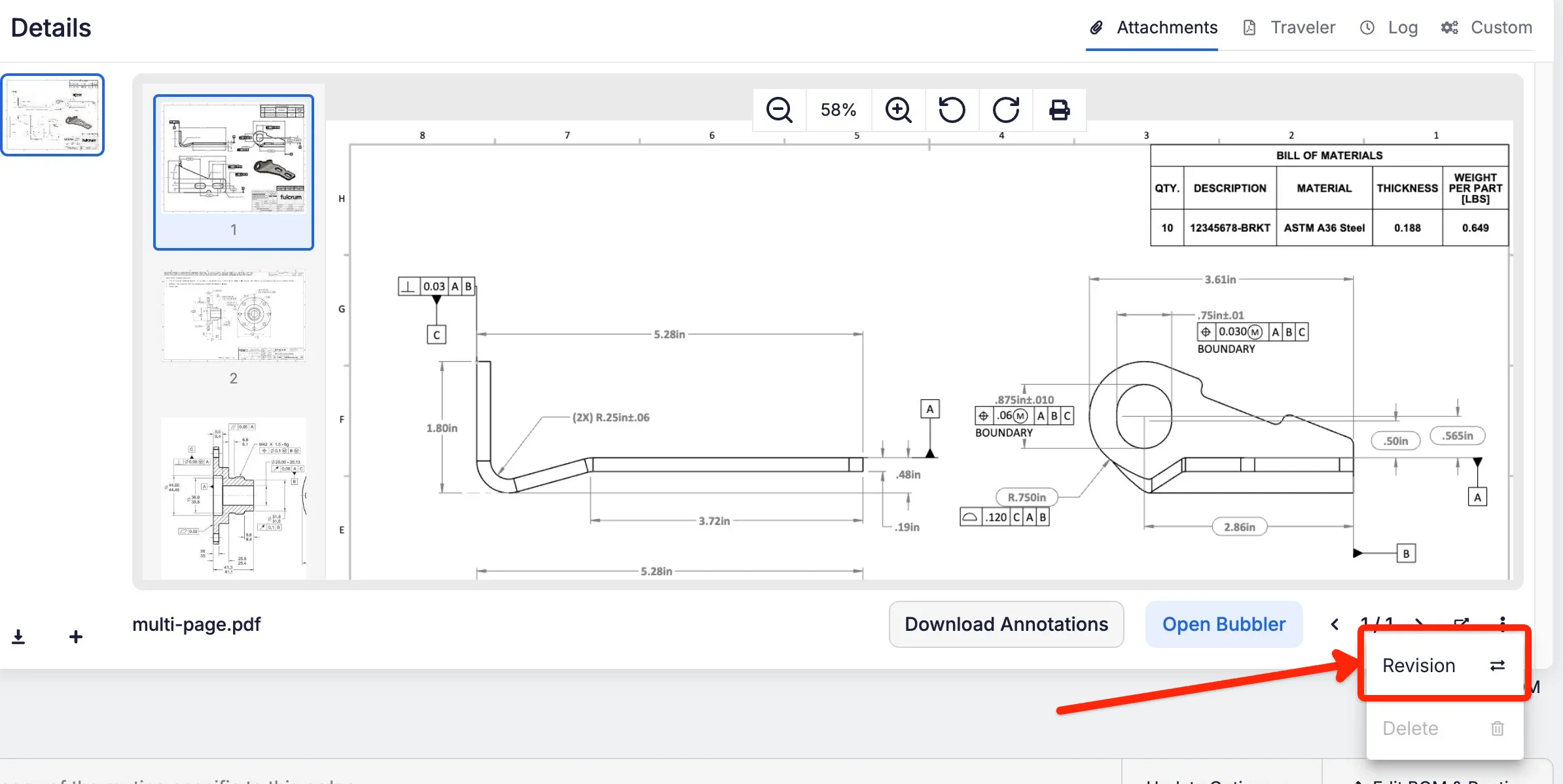
There's now a Revision button on the attachment menu. Upload the replacement PDF and Fulcrum copies the annotations, operator responses, and in-process tracking to the new drawing, retires the old one, and makes the new one primary. It's available on jobs and on items.
 Share ->
Your drawing can be in inches while your floor records in millimeters, or the other way around. Fulcrum now keeps the two in step everywhere, instead of leaving operators to convert in their heads.
Until now, in-process checkpoints were inspected on a fixed frequency: every Nth part, with no other option. You can now pick a sampling plan per checkpoint:
Set the plan on the checkpoint in the drawing annotator, and Fulcrum works out how many parts need inspecting once the job is approved. In Job Tracking, those checkpoints collect as a Random Sample count (First Article plus Sample 1 through N) instead of a column per part, and the operation can't be completed until every slot is filled. Results roll up to the job's Quality tab, the in-process tracking download, and the FAIR (First Article Inspection Report).
One limitation: sampling plans only work on checkpoints created in the drawing annotator, not ones added the older way.


