Why Your ERP Is Holding You Back
A new article by Tyler Buxton, Why Your ERP is Now a Liability, Not an Asset, is now live across Manufacturing.net and several other industry outlets including Industrial Equipment News and Automotive Design & Manufacturing. It will also reach thousands of manufacturing professionals through newsletter distribution this week.
The crux of Tyler’s argument is: the systems that once helped manufacturers scale are no longer keeping up with how decisions actually get made. A lot of manufacturers intuitively know this already, or are perhaps experimenting with AI already in their own ways. But Tyler makes the point that specific actions are required ASAP to avoid the scramble to come.
For decades, ERP systems have been the foundation of operations. As Tyler writes, they “were developed to move information out of filing cabinets and into digital systems,” which created a real advantage at the time. ERP systems were designed to store information, and rely on people to interpret data, run reports, and decide what to do next. In Tyler’s words, “ERP is a pull system. You need to ask for what you need.” That model worked when manufacturing moved more slowly. But It breaks down in an environment where timing, responsiveness, and speed increasingly define competitiveness.
What’s changing is not just the volume of data, but what software is expected to do with it.
Software as the Operator
AI is shifting software from passive storage to active participation. Instead of waiting for someone to run a report, systems can now surface issues, recommend actions, and in some cases execute them. Tyler describes this as a transition where “software [becomes] an operator,” not just a system of record.
In a traditional workflow, a late job might only be discovered after the fact or a margin issue might show up at the end of the month. Similarly, a scheduling problem might require a meeting to diagnose and fix. Each step introduces delay.
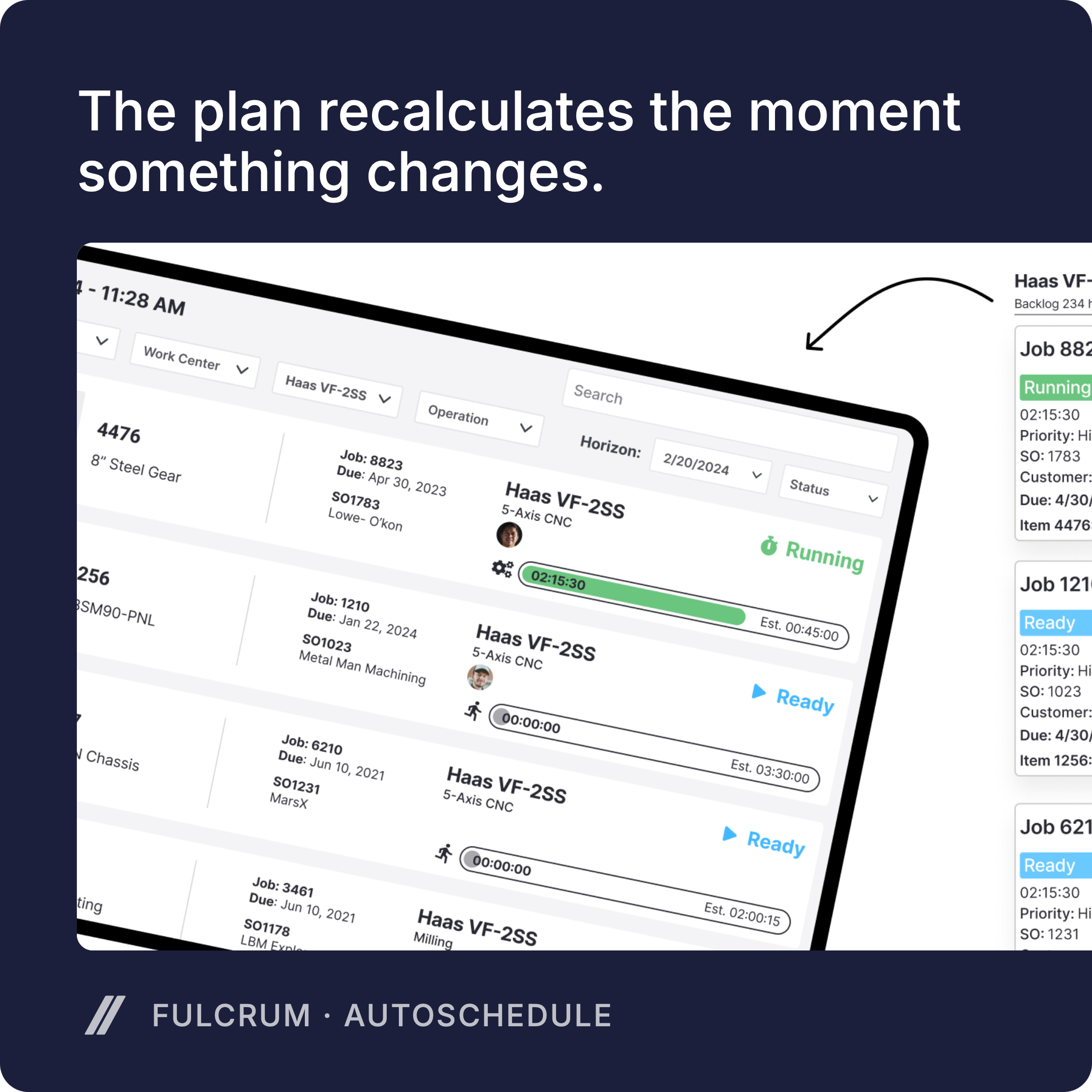
In a different model, those same issues are identified in real time. The system flags the problem, suggests the adjustment, and updates downstream decisions immediately. The gap between signal and action collapses.
This is why the article draws a parallel to the introduction of CNC machines. At the time, many shops hesitated to adopt them because manual processes still worked. But the companies that moved early gained a structural advantage in speed and precision.
“We are at a similar turning point now,” Tyler writes. “People saying ‘my ERP system works’ don’t yet understand that we’re in a different world.”
Data Digitization is Priority #1
The implication is not that ERP systems are obsolete overnight. It is that their role is changing, and relying on them as the primary decision engine is becoming a risk. “Those who wait won’t just miss out on growth,” the article notes. “They will soon start to lose loyal customers” to competitors who can move faster.
AI allows manufacturers to increase capacity without adding machines or headcount. It enables faster quoting, better pricing decisions, and tighter scheduling. Over time, those advantages compound. “The catch is that none of this works without accurate, digitized data,” Tyler writes.
AI is not a layer you can simply add on top of fragmented systems and expect results. It depends on clean, structured, connected information. Shops that have not invested in digitizing their operations will find themselves limited, regardless of how advanced the tools become.
On one side are companies using AI to summarize what already happened. On the other are companies using it to shape what happens next. The difference between those two approaches is the difference between incremental improvement and real competitive advantage.
TL;DR
ERP systems helped bring order to complexity. The next generation of systems will need to do more than organize information. They will need to interpret it, act on it, and adapt in real time. That is the standard the industry is moving toward.

Transcript
The full article is worth reading for anyone thinking about how their current systems support, or constrain, their ability to compete in that environment. Thanks to Nolan Beilstein, Associate Editor at Industrial Media LLC, for picking up Tyler’s story:
Industrial Maintenance & Plant Operations