Digitizing the Job Shop: How AI Is Reshaping Manufacturing from the Ground Up
In a recent episode of the Next-Gen Metal Fab Podcast, Fulcrum CEO Sunny Han sat down with host Tim Heston to talk about what AI actually means for manufacturing.
For years, manufacturers have been told to digitize their operations, clean up their data, and streamline processes before investing in automation. That advice still applies, but the consequences of ignoring it are now much more immediate.
“You can’t automate a bad process and make it a good process,” Sunny said. “And you can’t feed analog data into AI nearly as well as digitized information.” Many shops are still running on a mix of spreadsheets, paper, and institutional knowledge that lives in people’s heads.
Unfortunately AI doesn’t fix this disorganization, it exposes it.
The Bottleneck Is No Longer Just Process
Manufacturing conversations have long focused on process improvement. Lean, Six Sigma, workflow optimization. All important, but increasingly not the full picture. What’s slowing companies down today is how information moves.
In most shops, there is a lag between what happens and what gets learned from it. A job runs, data gets recorded, someone reviews it later, and maybe something changes next time. That loop can take weeks or months.
AI compresses that cycle dramatically. Shops can begin to see what’s happening as it happens, and adjust in real time. Instead of learning after the fact, they can respond in the moment. That shift changes how decisions get made. It also changes how fast a business can move.
Growth Without More People
One of the more striking ideas from Sunny and Tim’s conversation is that smaller shops could dramatically increase revenue without increasing headcount. Sunny suggested that a 20-person shop doing five or six million in revenue today could reach 20 or even 30 million if it makes the transition correctly.
The lever is not more labor, It’s speed.
Quoting faster, making decisions faster, moving work through the shop faster; reducing the time parts spend sitting between operations, removing friction from the front office — all of it adds up! Most shops don’t have a machine problem, they have a coordination problem.
Real-Time Decisions, Not Just Real-Time Data
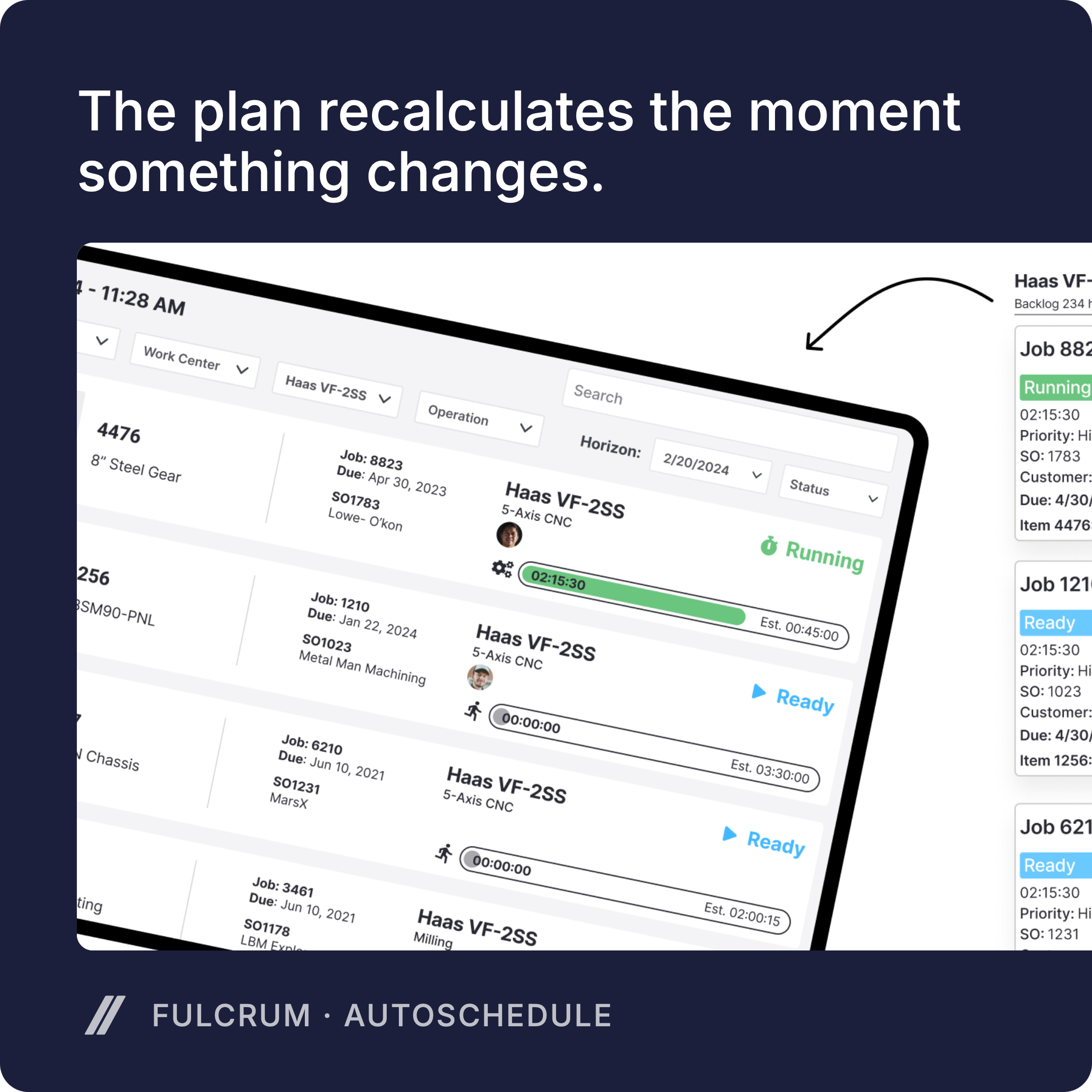
There is a lot of talk about real-time data, but the more important idea in Sunny’s view is what you do with it. The real opportunity is in creating decision loops that happen continuously. When something changes in the shop, that information should immediately influence what happens next.
If a job starts trending unprofitable, that insight should affect the next quote. If a supplier slips, scheduling should adjust automatically. If a quality issue shows up, it should inform future runs without waiting for a formal review. This view is what is driving how we are designing Archie, our Fulcrum AI, to serve customers. We understand this is less about dashboards and more about responsiveness.
The faster a shop can react, the more competitive it becomes. In most shops, quoting, scheduling, purchasing, and production are treated as separate functions. But in reality, they are tightly linked. A decision in one area affects all the others.
Everything Is More Connected Than We Pretend
AI makes it possible to treat these as parts of a single system instead of isolated workflows. Instead of optimizing one piece at a time, shops can start to optimize across everything at once. That kind of coordination has always been the goal, though it just hasn’t been practical until now.
Of course, none of this works without change at the shop level. Data needs to be digitized and knowledge has to be captured and shared instead of held informally. Teams have to get comfortable working in new ways, often with more transparency and less delay.
That kind of shift takes time and, culturally speaking, it can be uncomfortable. There is also a growing sense of urgency around how shops who delay may find themselves trying to catch up later, when the gap is much harder to close.

Transcript
TL;DR
The shops that benefit most will not be the ones that simply adopt new tools. They will be the ones that take the time to structure their data, rethink how information flows, and build systems that can actually support intelligent decision-making.
Listen to the full episode now on The Next-Gen Metal Podcast. Ready to try Archie? We’re ready when you are: (612) 502-0050.